Someone has Generously given $10,000 reward.. We Thank-You
*Please Do The Right Thing*


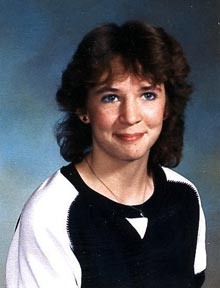


This past Saturday, September 18th 2010, our family was once again delighted to be able to award a young lady the "Sharron Prior Memorial Scholarship " for the sum of $2000.00.
It was an honor to present Kaylah Dupuis this special award.
Kaylah's dad (Robert Dupuis) was a very good friend of Sharron's, and Kaylah's mom (Kim Dryden), Moreen and I went to school together.
Congratulations and best wishes for the future
Prior Family
 If anyone has any information please do the following.
 Unsolved Murders of Canada By Lisa Wojna
“I’m your man,” it said.
He agreed to meet them at a restaurant. He brought his wife. What were the Priors hoping for? Recollections. Clues. He had always been “the beekeeper” to them, an essential but abstract figure in the most important event of their lives, and here he was, polite and solemn and real. He searched his memory and answered their many questions the best he could.
A couple of hours later the meeting was winding down, the silences between sentences growing longer.
“Would you take us there?” Yvonne asked suddenly. She had not been able to visit the place when it happened. Could not. Would not.
The man didn’t owe them anything. He’d already done more than most people would. Still, he didn’t hesitate.
“Of course,” he said.
The area was different. The woods were gone. A truck covers factory had gone up nearby. The small piece of land where the man had once kept his bees was now vacant.
He took them straight to the spot. Yvonne knew from newspaper photographs and maps she’d pored over that he was exactly right about the location. She marveled at his accuracy after all this time.
“It really affected him,” his wife said quietly.
A friend had called him that cold Tuesday morning. Did he know the gate to his beehives was open? That evening he walked over to check out the muddy field.
Yvonne stared at the spot. So many things had changed over the years. Suspects. Buildings. Faces. Memories.
One thing had not changed: the pain.
“Like an amputation of my soul,” Yvonne says...
A brute who raped and killed a teenager 26 years ago was jailed yesterday...trapped by his son's DNA.
Twisted Paul Hutchinson, 50, was caught when his son gave a sample after being arrested for a car offence.
Police found it was a partial match to evidence left after the 1983 death of Colette Aram, 16.
Father-of-four Hutchinson admitted the murder 25 years after the case became the first killing to appear on BBC1's Crimewatch.
Passing sentence, Mr Justice Flaux said the attack was "violent, twisted and perverted" and subjected Colette to "unimaginable terror and degradation".
He added: "It was a terrible act which has torn Colette's family apart and left a community haunted. "The killing was clearly premeditated.
You concealed your guilt for more than 25 years and only pleaded guilty when the evidence became overwhelming."
Hutchinson showed no signs of emotion and gazed at the packed gallery where Colette's family sat.
Her mother Jacqui Kirby, 62, now re-married and living in Greece, was comforted by exhusband Tony Aram, 68, and Colette's brother Mark, 45.
Outside Nottingham crown court she said: "We have spent 26 years wondering who murdered Colette. You could see Hutchinson has no remorse. There are still a lot of questions only he can answer."
Colette vanished in Keyworth, Notts, in October 1983 as she made the mile walk to the home of her boyfriend.
Her body was found in a field next day. She had been dragged at knifepoint into her killer's stolen car before being strangled, raped and beaten.
Another DNA caseThe Y-chromosome detection analysis is able to extend the evidence collection time from 48 hours on up to 120 hours, experts say.
It separates male DNA profiles from those belonging to females and hones in on tiny bits of saliva, skin cells, semen or other biological evidence.
Although the test has existed for at least eight years, some of the state's larger law enforcement crime labs have only recently become equipped to conduct their own analysis as the courts have become more accepting of newer kinds of technology.
"It's not a common kind of test you use all the time, it takes a considerable amount of work to get those systems up," said John Planz, associate director of the University of North Texas Center for Human Identification in Fort Worth, which has been working to refine the testing kits.
The Texas Department of Public Safety crime lab, which handles forensic testing for a various agencies across the state, including the El Paso Police Department, started conducting its own male-specific DNA tests in the middle of last year, DPS spokesman Tom Vinger said.
The Harris County Medical Examiner's Office biology lab also began using the test around the same time. Since June, it has obtained positive results in 20 sexual assault cases — most involving children — though none of those cases have gone to trial yet.
"Everyone recognizes (this) testing will work when traditional testing doesn't," Dr. Roger Kahn, the Harris County medical examiner's forensic biology director, told the Houston Chronicle. "The number of successes is up. Even we're surprised at some of these."
In the case of a 9-year-old girl who told authorities that a male relative molested her while she slept, there were no witnesses and no semen recovered. Harris County's supervisory forensic investigator Dan Morgan said testing using traditional DNA tests yielded inconclusive results. But testing using the new analysis found a partial DNA profile on swabs and portions of the girl's clothing that matched the suspect's.
Like a black light that causes white clothes and teeth to glow in the dark, the technology in the new test essentially makes the female DNA profile invisible and amplifies any male DNA, no matter how small, that may not have been seen before.
The male-specific DNA tests can also be used to solve crimes involving people of the opposite sex, such as burglaries or homicides that do not involve rape.
But the advanced tests only work in cases where a suspect has given a DNA sample to investigators looking at a specific crime, Kahn said.

1. Information Management – The Internet: If you can afford it, get a subscription to Lexis-Nexis. This will allow you to data mine old newspapers back to the early 80s. There’s gold in them hills.
2. Information Management – Your local library: Most major libraries keep copies of all regional newspapers on microfiche. For Theresa’s case I was able to have the Provincial Library in Quebec mail me microfiche of old newspapers like the Montreal Star, Photo Police, Allo Police to my local library in North Carolina! I know Doreen Prior also accessed local libraries for Sharon’s case. Newspapers offer you good information about activities in the area of investigation leading up to, and immediately after any murder.
3. Google is your best friend: I have Google Alerts set up for all key words associated with my sister’s death (names of regional towns, suspects’ names, the name of each regional police force). This is a good way to stay a step ahead of anything that may be relevant to your investigation.
4. Accessing public records: Things like medical records and autopsy reports… these are public information and readily available from your local medical examiner or coroner.
5. Makes friends with the appropriate law enforcement agency: In many circumstances a case grows cold due to perceived ineptitudes of the investigating police force. Despite the frustration you must ultimately make peace with the investigating force. Ultimately they are the only body that can bring the case to justice. Despite friction, you must work to find an understanding. This doesn’t mean you can’t continue to challenge the force, just realize that you must retain balance. Crime scene reports? Evidence? Primary information? All of this is in the hands of the investigating force. You must make amends if you hope to gain access to this information.
6. Make sure your case is registered in the appropriate national police cold case database: In the U.S. they use either ViCAP or CODIS. In Canada the system is called ViCLAS (in French SALVAC) . Even though these databases are maintained by the RCMP and FBI, it is the responsibility of regional forces to be trained on their use and to enter the data. Contact your regional police force to ensure your case is in the system.
7. Psychics: Useful? As secondary evidence, possibly. Just realize that anything psychic / medium offers is not admissible as evidence. It can be a great resource (myself and Bill have used them), but be aware of their limitations. And don’t get strayed into kooky theories: you can see patterns in any amount of randomness. Remember that some things are a coincidence.
8. Network: Read everything. The internet is an incredible resource. Become familiar with advocacy and justice initiatives. Make friends, get educated, attend conferences.
9. Publicity: The media can be a great tool to get your story out. Remember one thing: ultimately they are exploiting you, so feel free to exploit them. “If it bleeds it leads”… and the stories the media usually are attracted to in cold cases are something gruesome or something very personal ( perhaps too personal for a crime victim… I always hated when they asked me about “closure”). Be professional, cautious and guarded. Don’t offer up anything you feel is crossing a line. You have a right to say, “no, that’s too far” with these people. Also, don’t feel bad if they don’t want to cover your story. I have spent many hours offering up angles to media (suspects, new information, a personal-interest moment, a tidbit that is relevant to a current case), if they aren’t interested, don’t take it personally. Move on. It’s a business. One of the main reasons myself, Doreen and Bill started blogs was to control the distribution of information. So you can start one too! That too is media attention!
10. Get support: Guess what? You’re only human. And very quickly you will reach a burnout threshold. Get help. Find something positive other than this cold-case that gives you energy ( a hobby, your family, a sport, your shrink). We’ve all been to the bottom. It’s no fun, but we will support you on your journey back up. One of the best things I did? Made friends with fellow victims and investigating colleagues on Facebook. At first this seemed counter-intuitive: I wanted to isolate my personal life from my cold-case life. In the end it was the right decision because it was healthy to see these people without the victim stigma, in a normal light: families, loves, interests.
11. If all else fails: Contact the Vidocq Society, a group out of the Washington area comprised of retired forensic and investigative experts dedicated to solving old cases. Slightly pretentious, but if you’ve exhausted numbers 1 – 9 at this point you have nothing to lose. A word of caution: Vidocq will only consider your case if you have support from your local police jurisdiction (so no coming here if you’ve got a beef with how the police screwed up your case).
Go forth and solve!


